01. Define the boundary
Identify the source material, sensitivity, users, downstream systems, and deployment constraints before processing begins.

TRUST & PRIVACY
Across Media, Facility, and Infrastructure Intelligence, redaction runs inside the application before data is stored, shared, or handed to a downstream system. Source evidence, confidence, review status, and privacy treatment stay connected to the operational result.
TRUST THROUGHOUT
Trust is not a final review added after extraction. It starts with the data boundary and continues through processing, validation, and delivery.
Identify the source material, sensitivity, users, downstream systems, and deployment constraints before processing begins.
Extract information while retaining source references, confidence, configured privacy treatment, and the operating context required by the application.
Route uncertain, sensitive, or operationally important results through the agreed human or technical validation path.
Return accepted data with the evidence, review status, and privacy state required by the downstream workflow.
ACROSS ALL THREE APPLICATIONS
Apply configured redaction, preserve frame-level evidence, and route sensitive or uncertain results through review.
Review Media Intelligence Facility IntelligenceDetect people, screens, documents, and configured sensitive elements before imagery and asset records move downstream.
Review Facility Intelligence Infrastructure IntelligenceRetain source evidence, confidence, exceptions, and technical review status with accepted infrastructure data.
Review Infrastructure IntelligencePRIVACY IS PART OF THE APPLICATION
Media archives, occupied facilities, and field imagery can contain identifiable people, screens, documents, labels, and other sensitive content.
ContextFormers detects configured privacy-sensitive elements, applies the agreed obfuscation treatment, and retains review evidence before imagery or derived data is released to downstream users and systems.
Important or uncertain detections can be routed through a human-review path rather than treated as automatically complete.
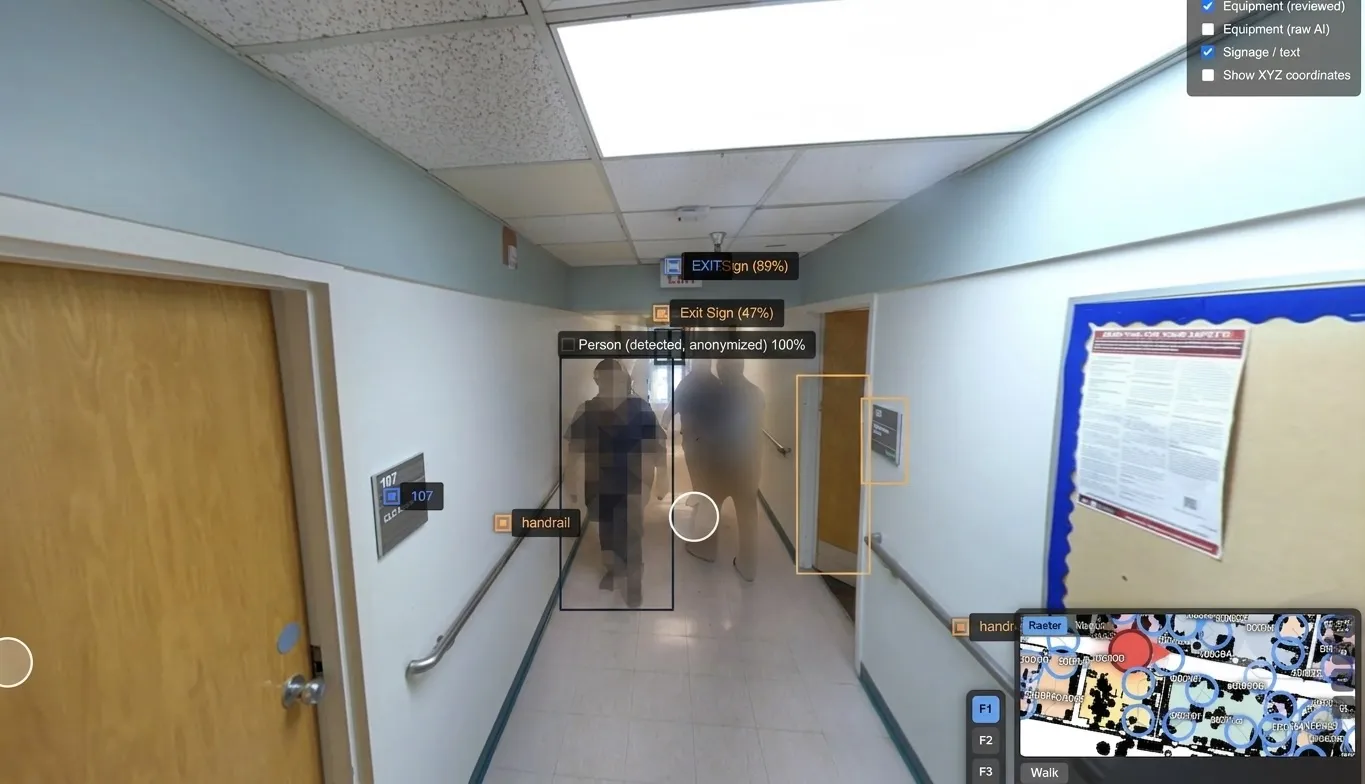
People detected and pixelated with confidence recorded. Room numbers, exit signs, and equipment identified in the same pass.
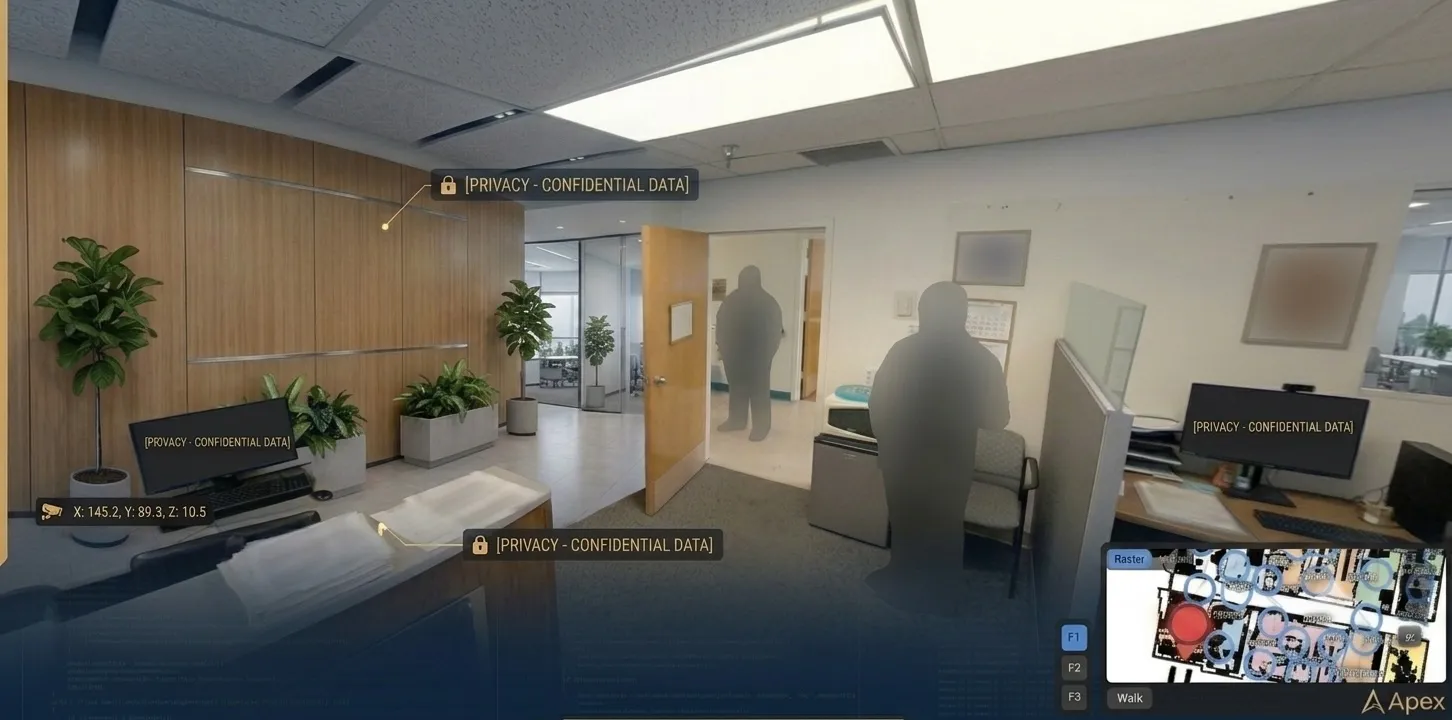
Monitors, documents, and people obfuscated with the configured treatment before the imagery moves downstream.
WHAT REDACTION COVERS
Redaction runs across all three applications rather than beside them — the same six capabilities whether the source is an archive, a facility scan, or field imagery.
Detects faces and full human figures in 360° panoramas, standard photos, and drone footage — including partial views, reflections, and people visible through windows or glass.
Identifies computer screens, whiteboards, printed documents, photos at desks, and other surfaces displaying readable text or identifiable information.
Detects protected health information visible in facility scans — patient charts, medication labels, bed assignments, diagnostic screens, and medical equipment displays.
Detected elements are obfuscated with the agreed treatment — blurring, pixelation, or solid masking — before the imagery enters storage, sharing, or further processing.
Every detection and obfuscation action is logged with what was found, where, its confidence, and the treatment applied, so the redaction pass can be reviewed rather than assumed.
Uncertain or operationally important detections can be routed through a human-review path before imagery is released — on whichever deployment model you run.
DEPLOYMENT OPTIONS
Deployment availability depends on the workload, integrations, security requirements, and technical scope. The choice is documented with the engagement.
Processing runs in ContextFormers-operated infrastructure with the data boundary, access model, retention, and project controls defined for the engagement.
A dedicated instance can be scoped for organizations that require stronger infrastructure separation and organization-specific operating controls.
For workloads that must remain in a customer-controlled environment, on-premises deployment can be evaluated as part of the technical scope.
Air-gapped packaging can be scoped for supported workloads where models and processing must operate without an outside network connection.
ENGAGEMENT-DEFINED CONTROLS
No generic configuration replaces decisions about the actual data, users, models, review path, retention, and downstream delivery.
Where processing runs, what data enters it, and what systems receive the result.
Who can access source material and outputs, how long data is retained, and how deletion is handled.
Which models, identity indexes, landmarks, taxonomies, and customer-specific configurations are used.
Confidence thresholds, human-review responsibilities, accepted schemas, evidence, and handoff requirements.
GET IN TOUCH
Tell us what the source material contains, who needs to use the result, and what operating constraints must be respected.
hello@contextformers.com